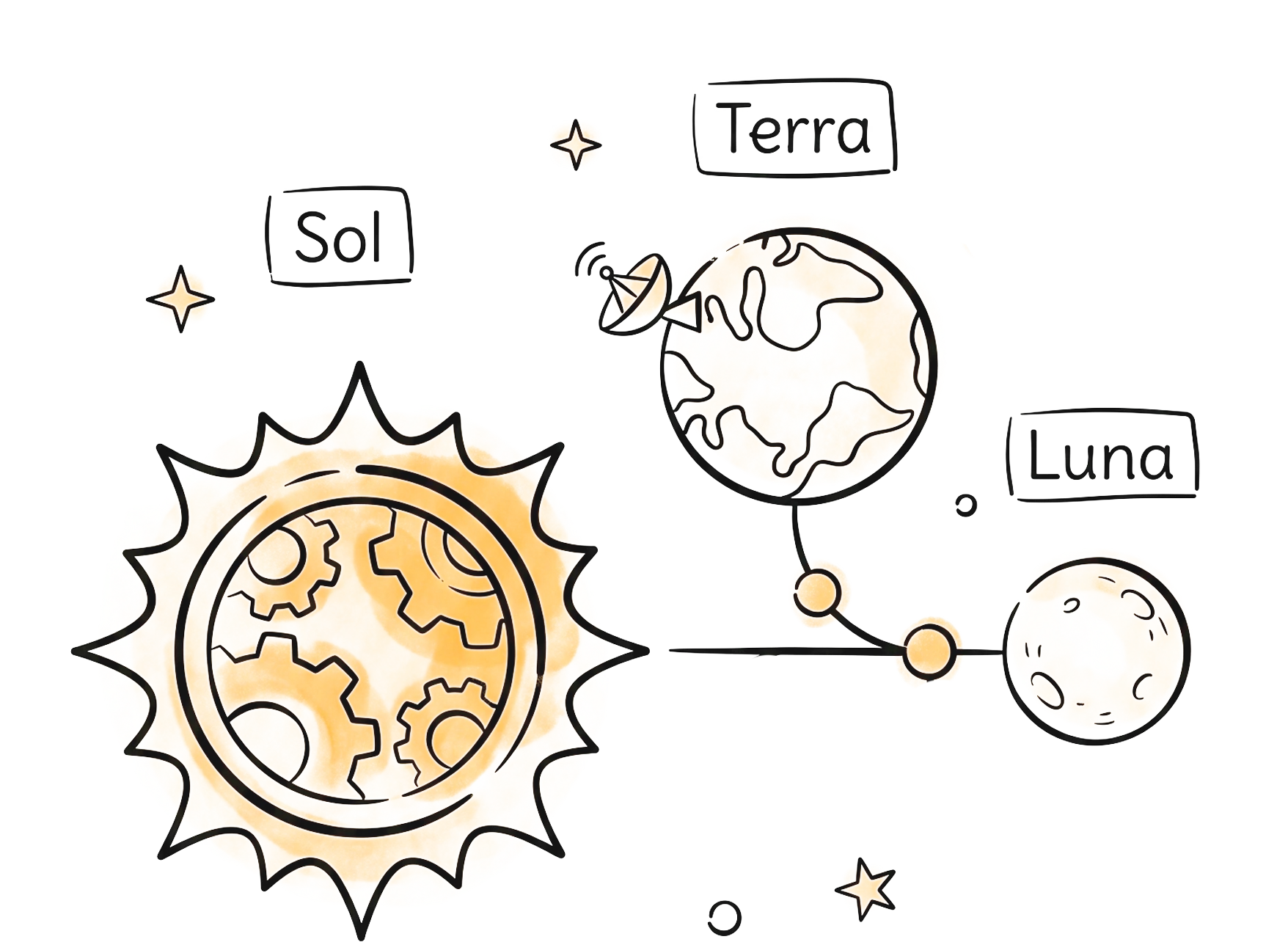
OpenAI has begun a limited preview of the GPT-5.6 series, made up of three distinct models. Sol is the flagship model, Terra is aimed at everyday work, and Luna focuses on speed and lower cost.
According to the company, Terra delivers performance competitive with GPT-5.5 while being twice as cheap. Luna, in turn, provides strong capability at the lowest price in the family.
The new naming approach separates the model generation, marked by the number, from the durable capability tiers identified by the names Sol, Terra and Luna. The stated goal is to offer clearer choices between intelligence, speed and cost.
Capabilities in coding, biology and cybersecurity
GPT-5.6 introduces a new reasoning level called “max”, which gives Sol more time to reason deeply. A new “ultra” mode is also added, using subagents to accelerate complex work.
In coding workflows, Sol reaches state-of-the-art results on the Terminal-Bench 2.1 benchmark. This test evaluates command-line workflows that require planning, iteration and tool coordination.
In biology, the model shows improvements on GeneBench v1, which is dedicated to genomics and quantitative-biology analyses. In cybersecurity, Sol proves to be the company’s most capable model on benchmarks such as ExploitBench and ExploitGym.
OpenAI notes that Sol is more effective at helping find and fix vulnerabilities than at carrying out end-to-end attacks. In evaluations on Chromium and Firefox it identified bugs but did not autonomously produce a full functional exploit.
Safety and automated red teaming
The GPT-5.6 series arrives with what OpenAI describes as its most robust safety stack to date. The protections combine several layers: filters trained into the model, real-time checks, account-level signals and continuous monitoring.
The company dedicated more than 700,000 A100-equivalent GPU hours to automated red teaming aimed at finding universal jailbreaks. This work is paired with human red teaming conducted with third-party testers.
Real-time classifiers assess the output as it is generated. In higher-risk cases, generation may be paused while a larger reasoning model reviews the conversation.
Availability and pricing
During the preview, the GPT-5.6 models are initially available through the API and Codex for a selected group of trusted partners. General availability is expected in the following weeks.
The price per one million tokens varies across the three models. Sol costs 5 dollars for input and 30 for output, Terra 2.50 and 15 dollars, while Luna stops at 1 dollar for input and 6 for output.
GPT-5.6 also introduces a more predictable prompt cache, with a minimum duration of 30 minutes. Cache reads keep the 90% discount on input, while cache writes are billed at 1.25 times the uncached input rate.
In July the company plans to launch Sol on Cerebras as well, with speeds up to 750 tokens per second for an initial group of selected customers.
Original article: openai.com