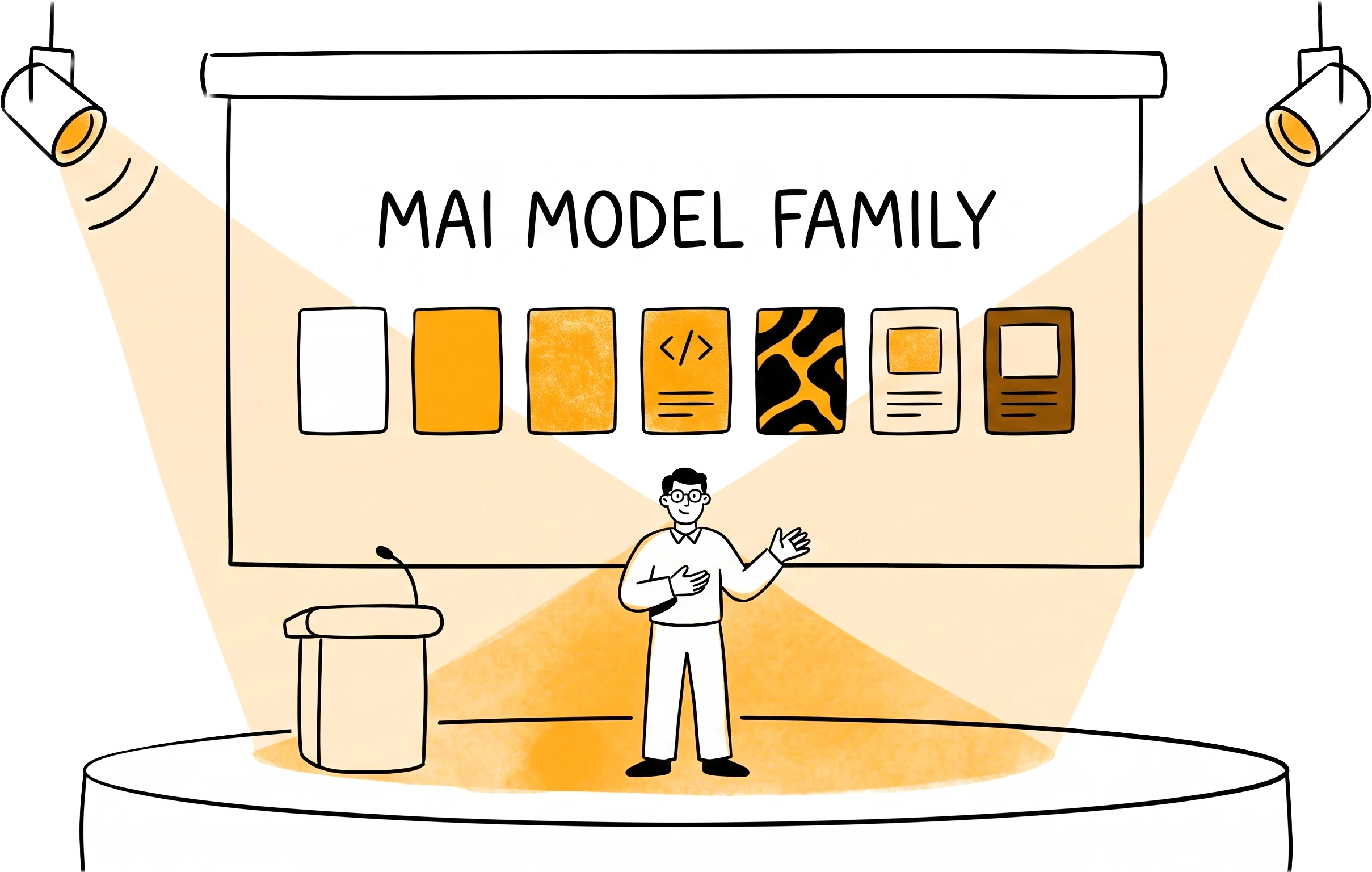
On 2 June 2026, Microsoft AI announced a family of seven new internally developed models, marking a significant step in the global race for artificial intelligence. The announcement, signed by Mustafa Suleyman — CEO of Microsoft AI — is accompanied by an ambitious vision: to build what the team calls a “hill-climbing machine”, capable of improving cycle after cycle by harnessing more computing power, better data and more precise evaluations.
The Seven Models of the MAI Family
The new MAI family of models covers multiple modalities and use cases, forming a multimodal ecosystem designed to integrate into existing products and workflows.
MAI-Thinking-1 is the flagship reasoning model. Medium in size, it was trained from scratch without distillation from third-party models and competes with the most advanced models in its category on software engineering and mathematical reasoning benchmarks. In human evaluations conducted with blind comparisons, it is preferred to Sonnet 4.6.
MAI-Code-1-Flash is an agentic model dedicated to code writing, designed for deep integration with GitHub Copilot and Visual Studio Code. With 5 billion active parameters, it is comparable to Haiku but at a lower cost.
MAI-Image-2.5 supports both text-to-image generation and photo editing, achieving competitive Arena ELO scores at a lower price than competitors.
MAI-Transcribe-1.5 is described as the best transcription model in the world: five times faster than competitors, with support for industry terminology in 43 languages.
MAI-Voice-2 generates natural speech in 15 languages with the ability to adapt to a voice from a short audio sample, with safeguards against misuse.
Frontier Tuning: AI That Learns from Real Work
Beyond the models themselves, Microsoft introduces the concept of Frontier Tuning: the ability to train MAI models directly on an organisation’s specific workflows, leveraging reinforcement learning in real environments. In practice, the most valuable data becomes the company’s own — the sequence of steps, decisions and actions that define how tasks are actually performed.
The announced results are significant: a MAI model optimised for Excel reaches the performance of GPT-5.4 while being up to ten times more efficient. According to Microsoft, Frontier Tuning represents the future of how AI manifests within organisations.
The Collaboration with Mayo Clinic for Healthcare
Among the flagship projects announced is a collaboration with Mayo Clinic to develop a frontier AI model for healthcare. The model will be built by integrating Mayo Clinic’s clinical expertise with Microsoft’s foundational capabilities and will be owned by the clinic itself, guaranteeing patient trust and clinical rigour. Once validated within the hospital system, it will be made available to other organisations through Microsoft Foundry.
The Vision: Humanistic Superintelligence
The ultimate goal declared by Microsoft AI is what Suleyman calls “Humanistic Superintelligence”: advanced AI systems designed to serve people and organisations, not to replace them. The emphasis is on maintaining human control and accountability towards human goals. In the coming months, a significant acceleration in computing capacity and capabilities is planned as the laboratory expands with new hires.
Original article: Microsoft.ai